Crookes Radiometer Manufacturer,Supplier and Exporter in Ambala
Product Code : SCL-PMP-11148
Crookes Radiometer - Lab Equipment Ambala
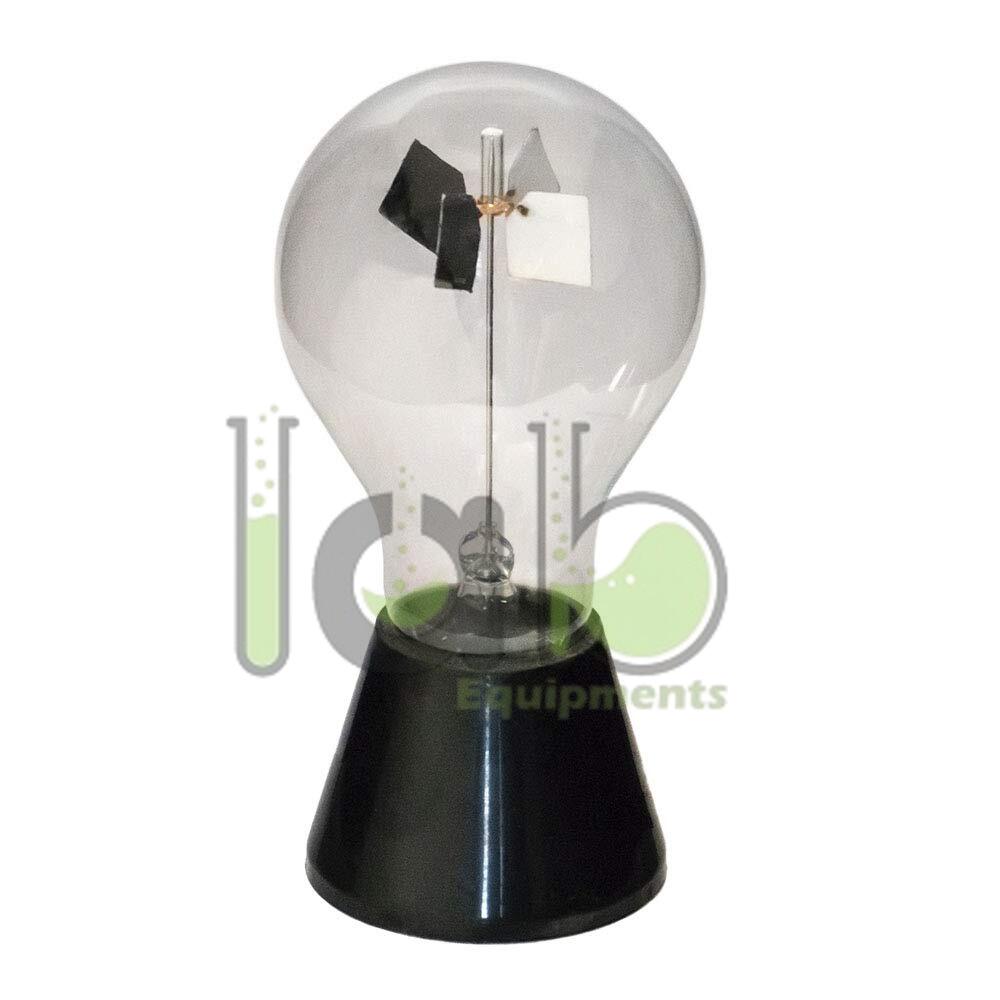
The Crookes Radiometer by Lab Equipment Ambala is an educational physics demonstration instrument designed to explain the effect of radiant energy, light, and heat on motion inside a low-pressure glass bulb. It is widely used in physics laboratories, schools, colleges, science exhibitions, and STEM learning environments for demonstrating radiation-related effects and basic thermal principles.
Product Overview
This apparatus is ideal for students, teachers, and physics laboratories. It demonstrates how light energy can create visible motion in a partially evacuated bulb fitted with lightweight vanes. The instrument helps learners observe and understand the relationship between radiation, heat absorption, and motion in a clear and engaging way.
Product Description
The Crookes Radiometer is a classic educational demonstration model used for showing the interaction of light, heat, and low-pressure gas behavior. When placed under a suitable light source, the internal vane assembly begins to rotate, making the concept visually effective for classroom teaching and laboratory study.
This helps students understand scientific ideas related to radiant energy, thermal effects, heat transfer, and observational physics. It is suitable for use in practical demonstrations, science exhibitions, and concept-based STEM activities.
Product Specifications
- Brand: Lab Equipment Ambala
- Product Type: Physics Radiation Demonstration Instrument
- Material: Glass bulb, lightweight vane assembly, spindle support
- Components: Transparent bulb, rotating vanes, black and light reflective surfaces
- Concepts Covered: Radiant energy, heat transfer, thermal effects, light-induced motion
- Operation Type: Observation under sunlight or bright light source
- Usage Level: Secondary to Undergraduate Physics
- Reusability: Yes
- Safety Note: Handle carefully as the apparatus contains a delicate glass bulb
Key Features
- Demonstrates radiation and thermal motion in a simple visual way
- Shows real-time vane rotation under light exposure
- Helps explain basic physics concepts clearly
- Supports STEM and science exhibition activities
- Compact and classroom-friendly design
How to Use
- Place the Crookes Radiometer on a stable flat surface.
- Keep the glass bulb clean for proper visibility.
- Expose the apparatus to sunlight or a bright light source.
- Observe the internal vanes begin to rotate.
- Explain the effect of radiant energy and heat during the demonstration.
Learning Tip: Use different light intensities to compare the speed of vane rotation during classroom demonstration.
Why Choose Lab Equipment Ambala?
Lab Equipment Ambala is committed to delivering reliable educational models and scientific instruments that simplify complex scientific concepts. Our products are designed for practical use, concept clarity, durability, and effective classroom learning.
Trusted by educators and institutions, Lab Equipment Ambala supports hands-on science teaching and laboratory-based education with dependable demonstration equipment.
Frequently Asked Questions (FAQs)
1. What does the Crookes Radiometer demonstrate?
It demonstrates the visible motion produced inside a low-pressure bulb when exposed to light and radiant energy.
2. Is it suitable for school students?
Yes, it is suitable for secondary, senior secondary, and college-level physics students.
3. Does it require electricity?
No, it works through exposure to sunlight or another bright light source.
4. Can it be reused?
Yes, it is designed for repeated classroom and laboratory demonstrations when handled carefully.
5. What concept does it explain?
It explains radiant energy effects, thermal behavior, and light-related motion in a simple visual manner.
Conclusion
The Crookes Radiometer by Lab Equipment Ambala is an essential educational tool for understanding radiation-related motion and thermal effects. It makes physics concepts visual, interactive, and easier to understand for students and educators.