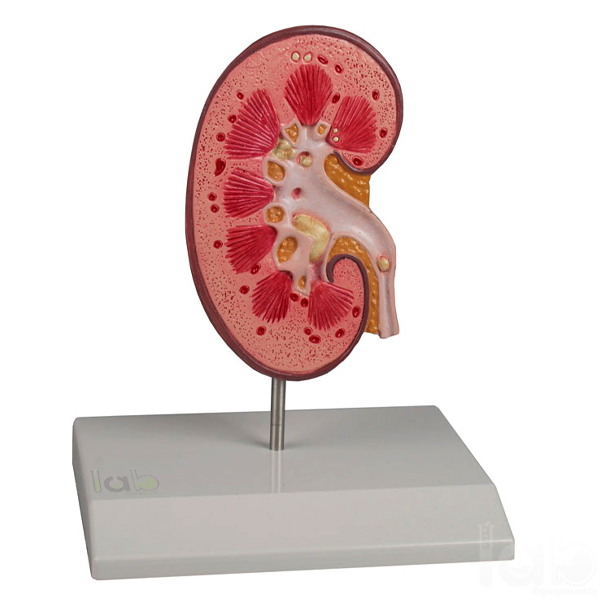
Quick Answer: Kidney Stone Model shows the kidney with the renal calices, renal pelvis and ureter opened to identify stone positions, and is used to explain kidney stones (nephrolithiasis) and urinary stones (urolithiasis).
Last updated: October 2026
Key Features
Renal calices, renal pelvis and ureter opened
Stone positions in the area of the renal pyramids and in the renal cortex
Stone at the origin of the upper calix group
Stones in the connecting tubules of the lower calix group, with congestion of the minor calices
Stone shown in the ureter
Mounted on a base, coloured and numbered with key card
Technical Specifications
Specification
Value
Opened structures
Renal calices, renal pelvis, ureter
Stone positions shown
Renal pyramids, origin of upper calix group, renal cortex, connecting tubules of lower calix group, ureter
Mounting
Base
Identification
Coloured and numbered, with key card
About This Product
The opened calices, renal pelvis and ureter let teachers point to each stone site in turn, including the lower calix group, where congestion leaves the minor calices partly closed and partly open. It is the Human System Model used to explain nephrolithiasis and urolithiasis.
Frequently Asked Questions
Q1. What conditions does the Kidney Stone Model explain? It is used to give information about kidney stones (nephrolithiasis) and urinary stones (urolithiasis).
Q2. Where are the stones shown? In the area of the renal pyramids, at the origin of the upper calix group, in the renal cortex, in the connecting tubules of the lower calix group and in the ureter.