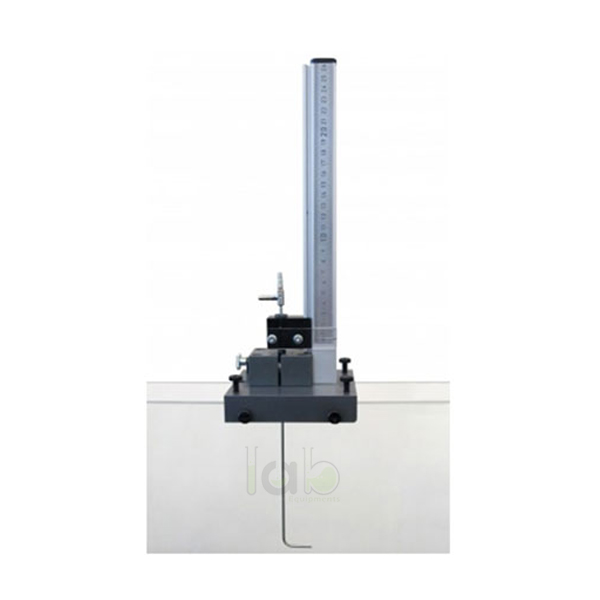
Quick Answer: Pitot Static Tube measures the flow velocity at any point in the experimental flume from the static and total pressure, shown on twin tube manometers. A vertical scale of 0…240 mm with 1 mm graduation indicates the position of the tube.
Last updated: October 2026
Key Features
Measures static and total pressure at any point of the flow
Twin tube manometers, connected by hoses, indicate both pressures
Tube moves vertically; holder with vertical scale shows its position
Carrier can be placed and fixed at any position on the experimental section
Technical Specifications
Specification
Value
Scale (vertical position)
0…240 mm
Graduation
1 mm
Pressure measuring range
2 x 0…350 mm WS
Dimension (L x W x H)
250 x 180 x 510 mm
Weight
Approx. 3 kg
About This Product
The pressure difference between the two manometer readings equals the dynamic pressure, from which the flow velocity is calculated. Because the carrier fixes anywhere along the experimental section and the tube travels vertically, students can measure velocity at different positions and depths in the EXPERIMENTAL FLUME FLOW CHANNEL APPARATUS.
Frequently Asked Questions
Q1. How is flow velocity obtained with the Pitot static tube? The tube measures static and total pressure; their difference is the dynamic pressure, from which the flow velocity can be calculated.
Q2. What is the pressure measuring range? The twin tube manometers measure 2 x 0…350 mm WS.
Lab Equipments Ambala supplies institutions and distributors in Senegal, Bhutan and Latvia, as part of its export work to 80+ countries.