Resonance Box Tuning Fork Assembly

Resonance Box Tuning Fork Assembly

Product Code : SCL-PMP-11309

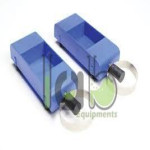
The Resonance Box Tuning Fork Assembly is an educational acoustics apparatus used to demonstrate natural frequency, forced vibration and sound amplification through resonance. A mounted tuning fork transfers vibration to a hollow resonance box, producing a louder and more readily observable tone for classroom and laboratory experiments.

Product Description

The assembly combines a fixed-frequency tuning fork with a hollow acoustic box designed to respond near the fork’s natural frequency. When the fork is struck correctly, vibration passes through its stem and mounting point into the box. The vibrating surfaces and enclosed air reinforce the sound, making the tone more audible than that produced by the unsupported fork alone.

The apparatus can be used individually or with a second matching assembly to demonstrate sympathetic resonance. It also supports lessons on natural frequency, amplitude, energy transfer, damping and coupled oscillation. The supplied fork frequency, box dimensions, material, cavity tuning and component quantities must be confirmed before procurement.

Key Features

  • Mounted tuning fork: Holds the fork securely while allowing vibration transfer through the stem.
  • Acoustic resonance box: Reinforces the fork’s tone through vibration of the box and enclosed air.
  • Natural-frequency demonstration: Helps explain why systems respond strongly at particular frequencies.
  • Sympathetic resonance potential: Two matched assemblies can demonstrate vibration transfer between equal-frequency forks.
  • Visible and audible learning: Combines observable prong motion with enhanced sound output.
  • Manual operation: Requires no electrical supply for standard experiments.
  • Reusable laboratory apparatus: Suitable for repeated sound, vibration and resonance lessons.

Technical Specifications

Specification

Detail

Product name

Resonance Box Tuning Fork Assembly

Brand

Lab Equipments Ambala

Product category

Acoustic Resonance and Tuning Fork Apparatus

Scientific principles

Natural frequency, resonance, vibration transfer and sound amplification

Power requirement

None

What's Included

  • Tuning fork or matched tuning-fork pair
  • Resonance box or boxes
  • Fork mounting blocks or fittings
  • Soft rubber striker
  • Storage case or protective packaging
  • Experiment and care instructions

Applications

  • Demonstrating amplification of sound through resonance.
  • Studying the natural frequency of a tuning fork.
  • Comparing supported and unsupported tuning-fork sound levels.
  • Demonstrating sympathetic resonance with matched forks.
  • Explaining vibration transfer through a solid mounting point.
  • Introducing damping, amplitude and coupled oscillation.

Related resources include the Tuning Fork Set of 8, the Doppler Effect Kit, the company’s Physics Laboratory Equipment Guide and broader Physics Laboratory Equipment.

How to Use the Resonance Box Tuning Fork Assembly

  1. Place the resonance box on a stable laboratory surface.
  2. Confirm that the tuning fork is securely mounted by its stem.
  3. Hold the box steady without touching the fork prongs.
  4. Strike one prong gently with a suitable soft striker.
  5. Listen to the amplified tone produced by the box.
  6. Compare the sound with the same fork held away from the box where practical.
  7. For sympathetic resonance, position a matched assembly nearby and damp the first fork after excitation.
  8. Observe whether the second fork continues to produce sound.

Safety note: Strike the fork only with a soft striker. Do not hit it against metal, glass or the laboratory bench, and do not place vibrating prongs directly against the ear.

Care & Maintenance

  • Wipe the tuning fork with a clean, dry cloth after handling.
  • Protect the prongs from bending, corrosion and hard impacts.
  • Keep the resonance box dry and protect it from cracks or loose joints.
  • Do not file, grind or modify the fork, as this changes its frequency.

Why Choose Lab Equipments Ambala

Lab Equipments Ambala manufactures and supplies educational physics apparatus and sound-experiment equipment from Ambala, India. Its physics range includes tuning forks, Doppler-effect kits and apparatus for vibration, wave and resonance demonstrations. The company supplies schools, colleges, universities and institutional laboratories. Buyers should request the confirmed fork frequencies, box construction and component-level packing list before ordering.

Frequently Asked Questions

What is a Resonance Box Tuning Fork Assembly used for?

It is used to demonstrate tuning-fork vibration, natural frequency, sound amplification and acoustic resonance.

Why does the resonance box make the fork sound louder?

The fork transfers vibration to the box, whose larger vibrating surfaces and enclosed air move more air and reinforce the sound.

Can the apparatus demonstrate sympathetic resonance?

Yes, when two compatible assemblies with matching or sufficiently close frequencies are supplied.

Which tuning-fork frequency is included?

The supplied frequency is not published for this exact assembly and must be confirmed before ordering.

Is the resonance box made from wood?

The box material is not confirmed. Request the construction material, dimensions and finish from the manufacturer.

Does the assembly require electricity?

No. The tuning fork is mechanically activated and requires no electrical supply.

Request the confirmed fork frequency, resonance-box dimensions and packing list, or explore the Physics Laboratory Equipment category for related sound and wave apparatus.

   
Supply of Resonance Box Tuning Fork Assembly from to Finland, France, Tanzania, Thailand, Sri Lanka, Congo, Costa Rica, Ivory Coast, Croatia, Cuba, Cyprus, Czech Republic, Denmark, Djibouti, Dominica, Afghanistan, Albania, Algeria, Andorra, Angola, Antigua and Barbuda, Argentina, Armenia, Australia, Austria, Azerbaijan, Bahamas, Bahrain, Bangladesh, Barbados, United Arab Emirates (UAE, Dubai), United Kingdom (London), United States, Uruguay, Uzbekistan, Vanuatu, Belarus, Belgium, Belize, Benin, Bhutan, Bolivia, Bosnia and Herzegovina, Botswana, Brazil, Brunei, Bulgaria, Burkina Faso, Burma Myanmar, East Timor, Ecuador, Egypt, El Salvador, Equatorial Guinea, Eritrea, Estonia, Ethiopia (Addis Ababa), Fiji, Burundi, Cambodia, Cameroon, Canada, Cape Verde, Central African Republic, Chad, Chile, Colombia. Math Teaching Kit suppliers in Luxembourg, Macedonia, Madagascar, Malawi (Lilongwe), Malaysia (Kuala Lumpur), Maldives, Mali, Malta, Marshall Islands, Mauritania, Mexico, Micronesia, Moldova, Monaco, Mongolia, Montenegro, Morocco, Mozambique, Namibia, Comoros, Congo. Math Teaching Kit manufacturers in Dominican Republic, Gabon, Gambia, Georgia, Germany, Ghana, Greece, Grenada, Guatemala, Guinea, Guinea-Bissau, Guyana, Haiti, Honduras, Hungary, Iceland, Indonesia, Iran, Iraq, Niger, Nigeria (Abuja), Norway, Oman, Palau, Panama, Papua New Guinea, Paraguay, Peru, Philippines (Manila), Poland, Ireland, Israel, Italy, Jamaica, Japan, Jordan, Kazakhstan, Kenya (Nairobi), Kiribati, Korea, Kuwait, Kyrgyzstan, Laos, Latvia, Lebanon, Lesotho, Liberia, Liechtenstein, Lithuania, Mauritius, Nauru, Nepal, Netherlands, New Zealand, Nicaragua, Portugal, Qatar, Romania, Russia, Rwanda (Kigali). Math Teaching Kit exportets to Saint Kitts and Nevis, Saint Lucia, Saint Vincent and the Grenadines, Samoa, San Marino, Sao Tome and Principe, Saudi Arabia, Senegal, Serbia, Seychelles, Sierra Leone, Singapore, Slovakia, Slovenia, Solomon Islands, Somalia, South Africa, South Sudan, Spain, Sudan, Suriname, Swaziland, Sweden, Switzerland, Syria, Tajikistan, Togo, Tonga, Trinidad and Tobago, Tunisia, Turkey, Turkmenistan, Tuvalu, Uganda (Kampala), Ukraine, Venezuela, Vietnam, Yemen , Zambia (Lusaka), Zimbabwe

Office Address

Works: Block-10 Naraingarh Chowk Crossing, Baldev Nagar,
Ambala, Haryana 134003,

[email protected]

Follow Us